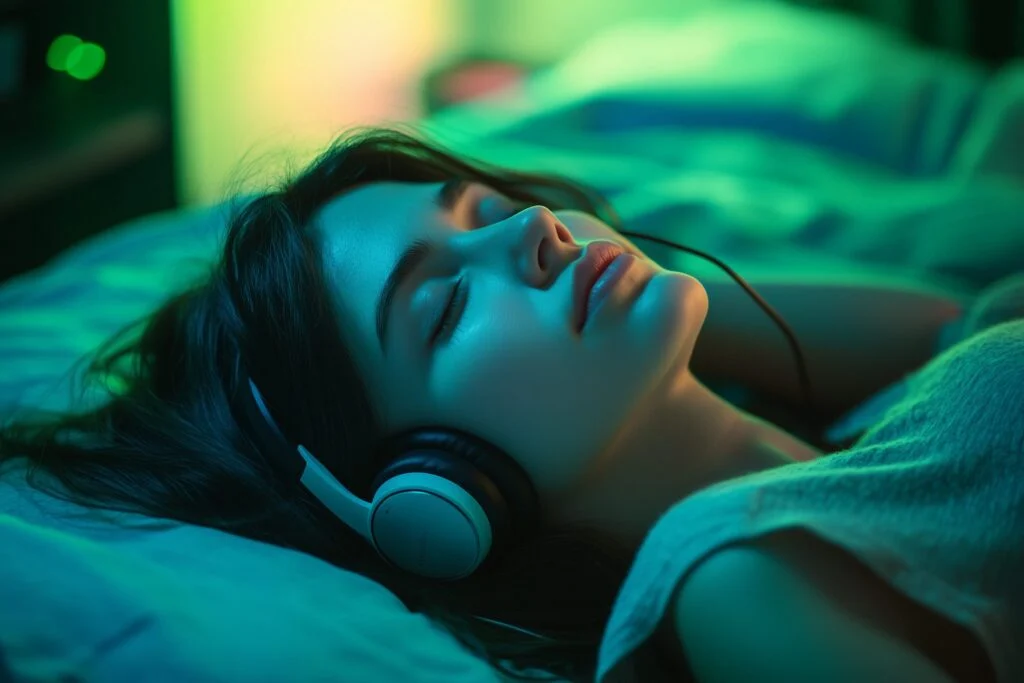
The Science of Sleep Soundscapes: Why Nature Sounds Help You Sleep Better
Silence isn't always the best environment for sleep. For many people, a completely quiet room makes the brain hypersensitive to sudden sounds — a floorboard creak, a distant car, a ticking clock. In a quiet room, every acoustic event is a potential threat the brain must evaluate. This is where the science of soundscapes and auditory masking becomes genuinely useful for sleep quality.
How Sound and Sleep Architecture Actually Interact
To understand why soundscapes work, it helps to understand sleep architecture — the stages your brain cycles through each night.Sleep consists of four stages: N1 (light onset), N2 (consolidated light sleep), N3 (deep slow-wave sleep), and REM (dreaming and emotional processing). You cycle through these roughly every 90 minutes all night.
N3 slow-wave sleep is the most physically restorative stage. During N3, your brain produces delta waves and performs critical recovery work — clearing toxic metabolic waste via the glymphatic system, consolidating procedural memory, and repairing tissues. Any external acoustic disruption above ~45 dB can pull you into lighter sleep stages, reducing N3 time.
Soundscapes don't push you into deeper sleep. They prevent the disruptions that pull you out of it.
Experience StillKoi for Yourself
Put these insights into practice with guided breathing, meditation, and wellness tools.


The Power of Auditory Masking
Auditory masking underlies most sleep sounds: a steady, consistent sound raises the baseline noise floor in your bedroom. Sudden acoustic events — a car alarm, a door, a partner shifting — become less dramatic by comparison.Scientifically, this is described as reducing the signal-to-noise ratio. The masking sound is the constant "noise"; the disruption is the "signal." By compressing this ratio, your sleeping brain is less likely to register sharp events as requiring a response — and less likely to pull out of deeper sleep stages.
White Noise, Pink Noise, and Brown Noise: What's Actually Different
White noise contains equal energy at every audible frequency, including significant high-frequency content. Acoustically, it sounds like an untuned analog television or an industrial fan. It's highly effective at broad-spectrum masking but has notable high-frequency harshness that some nervous systems — particularly anxious or sensitive ones — continue to process rather than accept.Pink noise rolls off at about 3 dB per octave as frequency increases, resulting in a warmer, softer sound similar to steady moderate rainfall or a gentle breeze. Pink noise has the most substantial research base of any noise color specifically for sleep. A landmark study in *Frontiers in Human Neuroscience* (Ngo et al., 2013) found that pink noise synchronized to slow-wave sleep oscillations increased deep sleep quality and next-day declarative memory consolidation by up to 23%. A 2021 follow-up found similar benefits for older adults, whose slow-wave sleep naturally declines with age.
Brown noise (Brownian noise) has even heavier emphasis on low frequencies — a deep, rumbling quality resembling heavy rain, a large waterfall, or distant ocean waves. Many people with anxiety, ADHD, or racing-mind patterns find brown noise more effective than white noise. The heavy low-frequency energy is grounding but non-intrusive; it anchors attention without activating the auditory cortex's pattern-detection systems at the high end.
Natural soundscapes — forest, rain, ocean — combine elements of pink and brown noise with biological familiarity. Research from *Scientific Reports* (Gould van Praag et al., 2017) demonstrated that natural sounds increase parasympathetic nervous system activity and reduce self-reported stress more effectively than synthetic white noise. The mechanism is partly acoustic (spectral properties) and partly evolutionary (millions of years of associating these sounds with shelter and safety).
Matching Sound Type to Your Sleep Problem
Not all sleep difficulties respond to the same sound. Here's a practical guide:| Sleep Problem | Best Sound Approach |
|---|---|
| Trouble falling asleep (racing mind) | Brown noise or forest soundscape |
| Waking during the night (noise disruptions) | Pink noise for sustained overnight masking |
| Light, unrefreshing sleep | Pink noise (best evidence for deep sleep enhancement) |
| Anxiety-driven insomnia | Rain sounds or ocean waves |
| Partner snoring | White noise or brown noise (maximum masking power) |
| ADHD / highly stimulated mind | Brown noise (low-frequency, non-intrusive) |
If you're unsure which category fits you, look at the wired-but-tired paradox and why your mind races at night for more context on your specific pattern.
How Natural Sounds Interact with the Nervous System
Beyond masking, natural soundscapes appear to directly modulate the autonomic nervous system. The *Scientific Reports* study showed measurable increases in parasympathetic nervous system activity when listening to nature sounds, compared to synthetic noise or silence.The mechanism connects to Stephen Porges' Polyvagal Theory: our nervous systems are wired to read environmental acoustic cues as indicators of safety or threat. Human voices in certain tones, urban mechanical noise, and sudden sounds can activate alert states. Flowing water, rustling leaves, mid-range birdsong, and rain signal environmental safety — triggering the physiological permission to rest. Our brains evolved in these soundscapes; they are deeply encoded as "nothing to worry about."
This is why silence can sometimes create more anxiety than calm. The nervous system reads safety through acoustic context, and familiar natural sound is its most ancient safety signal.
Volume and Timing: The Variables People Get Wrong
Volume: Research consistently points to 45–50 dB as the optimal range — roughly the level of quiet conversation in a room. Louder than this can create its own acoustic stress and potential long-term hearing exposure issues. Quieter than this provides insufficient masking or grounding. The sound should be clearly present without being the focus of attention.Duration: For sleep onset difficulties, 45–60 minutes is typically sufficient — the brain uses the sound to transition and then can sustain sleep without it. For people who wake frequently in the night or live in noisy environments, looping sound throughout the night provides better protection.
Loops: Avoid soundscapes with noticeable loop points. The brain — even during sleep — is exquisitely sensitive to pattern detection. A predictable reset point can become the cue that keeps a portion of the auditory system continuously alert. High-quality, long-form recordings with natural variation avoid this problem.
Consistency: The most underrated variable. Using the same soundscape every night creates a conditioned sleep cue — a Pavlovian association between the specific sound and the onset of physiological sleep preparation. This builds over 1–2 weeks and makes the same sound progressively more effective. This is one reason StillKoi is designed for daily use rather than occasional listening.
Practical Setup: Creating Your Optimal Sound Environment
1. Choose your sound type based on your primary sleep problem (see table above) 2. Set volume to 45–50 dB — audible but not dominant from the bed 3. Use the same sound every night for 2 weeks minimum to build the conditioned cue 4. Ensure long recordings without obvious loop points 5. Pair with dim, warm lighting after 9 PM to support the melatonin rise that sound is trying to protect 6. Combine with circadian rhythm optimization for a comprehensive sleep environmentFrequently Asked Questions
Is it safe to sleep with sound every night?Yes, at appropriate volumes (under 55 dB). The concern with constant sound exposure applies to much louder environments — construction, traffic, concerts. Sleep soundscapes at recommended volumes have been studied positively for sleep quality improvement, with no evidence of auditory harm in adult populations.
Do soundscapes work for children?
Yes — evidence suggests they may be especially effective for children, whose sleep is frequently disrupted by household noise. White or pink noise at moderate volume is a common pediatric sleep recommendation. Avoid placing speakers closer than 2 meters from infants' cribs.
Can I use music instead of soundscapes?
Music with lyrics actively engages language processing centers of the brain, which competes with sleep onset. Slow instrumental music (under 60 BPM) can work, but continuous non-melodic soundscapes are more reliable because they require no active cognitive processing.
Why does rain sound so universally soothing?
Rain is acoustically close to pink noise (frequency balance), repetitive but naturally variable (no detectable loop point), deeply associated with shelter-seeking behavior throughout human evolution, and primarily composed of mid-frequencies the nervous system most associates with calm. It combines every perceptual property that makes a sound sleep-conducive.
Should I play sound all night or just for sleep onset?
If your primary problem is falling asleep: 45–60 minute timer is enough. If your problem is waking during the night or you're in a noisy environment: all-night looping provides more consistent protection. If you're sensitive to sound or trying to avoid any dependency, the timer approach works fine for most people.
---
*Scientific References:*
*Ngo et al. (2013) – Auditory Closed-Loop Stimulation of the Sleep Slow Oscillation Enhances Memory. Neuron.*
*Gould van Praag et al. (2017) – Mind-Wandering and Alterations to Default Mode Network Connectivity When Listening to Naturalistic versus Artificial Sounds. Scientific Reports.*
*Papalambros et al. (2017) – Acoustic Enhancement of Sleep Slow Oscillations and Concomitant Memory Improvement in Older Adults. Frontiers in Human Neuroscience.*
*Porges (2011) – The Polyvagal Theory: Neurophysiological Foundations of Emotions, Attachment, Communication, and Self-Regulation.*
The StillKoi Team
We research the neuroscience of rest, focus, and stress recovery to help you build a calmer, more intentional daily life. Every article is grounded in peer-reviewed research and practical, real-world application.
Related Articles


Try StillKoi
Your calm, on demand
Experience personalized wellness with natural sound mixing, guided breathing, and daily rituals.